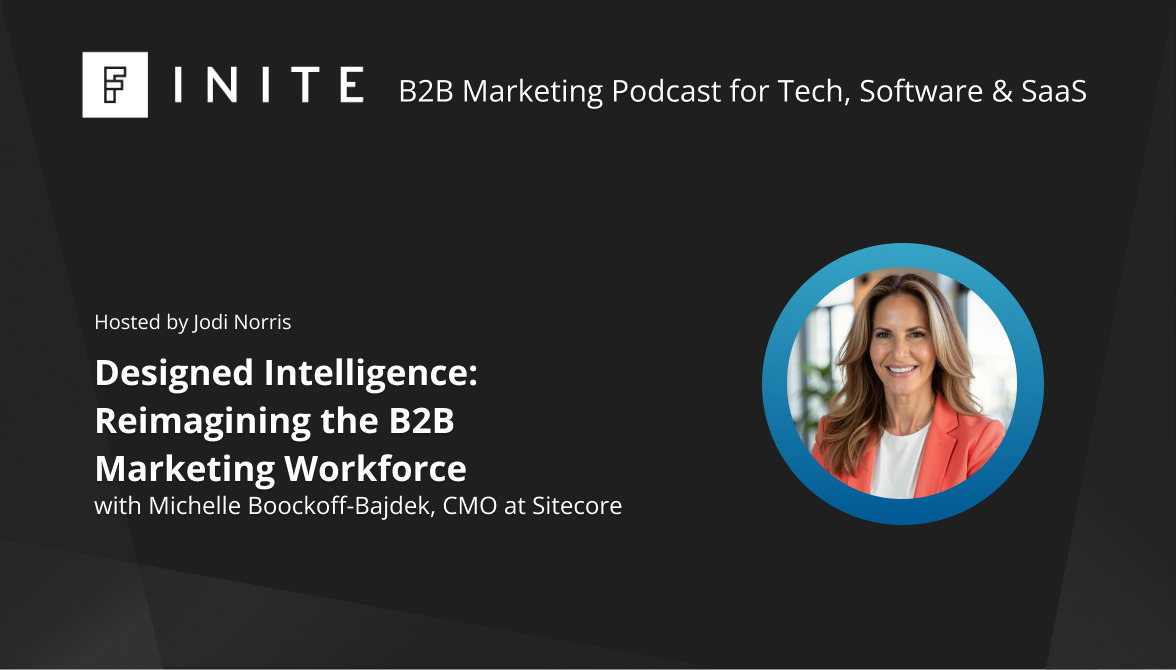
How do you move from simply “using” AI to truly integrating it into your workforce? In this episode, Michelle Boockoff-Bajdek, CMO of Sitecore, introduces her philosophy of Designed Intelligence – the intentional choreography between human creativity and AI capability.
Michelle breaks down why the future of marketing isn’t about chasing cost efficiencies, but about scaling empathy and connection. She shares how Sitecore is evolving its org charts into agile squads, the shift from personalised to “permissioned” marketing, and why curiosity is the most important skill for the modern marketer. Discover how to treat AI as a teammate rather than a tool to build deeper trust with your audience.
- The Human-AI-Human Model: Why humans must lead the strategy, AI must accelerate the output, and humans must provide the final review.
- Organisational Evolution: Moving from channel silos to agile squads supported by “AI teammates.”
- Permissioned vs. Personalised: How to maintain brand authenticity and trust in an era of industrial-scale synthetic media.
- The Future of the CMO: Shifting from a campaign engine to a real-time experience engine.
Listen below, on Apple Podcasts or Spotify
Or watch on YouTube
And once you’re done listening, find more of our B2B marketing podcasts here!
The FINITE Podcast is sponsored by Clarity, a full-service digital marketing and communications agency. Through ideas, influence and impact, Clarity empowers visionary technology companies to change the world for the better.
Find the full transcript here:
Jodi: Michelle, thank you for joining me on the FINITE Podcast.
Michelle BB: Oh, thank you so much for having me. I am really excited about our discussion today.
Jodi: Me too. We’re delving into what you have called—you have kind of “TM’d”—Designed Intelligence, which sounds like a really exciting topic. Before we do, I would love to hear a little bit more about your career; you’re the CMO at Sitecore. How did you get here? Tell us a bit about your journey.
Michelle BB: I am happy to give you a bit of my background, though I’ve been in marketing longer than I sometimes want to admit! I’ll shorten it for this conversation. What I think is most interesting is that I didn’t start in a glamorous strategy role; I actually began as an administrative assistant at a promotional agency. This was at a time when not everybody had a personal computer, so I spent my time typing up creative briefs from account executives and creative directors. While tedious, it was a great way to learn the business from the ground up.
I eventually moved into product marketing at a tech firm and fell in love with the challenge of translating complex ideas into something anyone could understand. From there, I worked for all different sizes of companies, from startups to IBM. At IBM, you learn what it means to operate at a global scale. Now at Sitecore, there’s a common thread across all these jobs: the intersection of technology and humanity. I love helping people understand the promise of tech and how it can make life better.
If I look at the “secret sauce” of my career, I’ve been fortunate to have remarkable female leaders who invested in me long before I believed I belonged in the room. Mentoring the next generation is one of my favorite things to do. My best “mentor gig” right now is sitting upstairs: my 22-year-old daughter has chosen to step into marketing as a content and social media marketer. Watching her find her voice is the most rewarding thing ever.
Jodi: That’s so inspiring. I love that you mention mentorship, especially for women. Amazing stuff. I’m assuming we’re going to be discussing this interwoven dependency between tech outputs and the impact on business, humanity, society, and science. To start us off, I’d love to get your definition of your term, Designed Intelligence. What does that mean to you, and where did it come from?
Michelle BB: It gets to the heart of how the marketing industry is changing. AI isn’t new—we’ve used it for decades—but the accessibility of Generative AI is new. Anyone can engage with it now; it’s been democratized. But the real shift is what I call “behavioral seepage.” When AI becomes effortless in your personal life (planning trips, drafting emails), it inevitably follows you into your work life.
Designed Intelligence is the intentional choreography between human creativity and AI capability. It’s not just bolting a tool onto your tech stack; it’s thinking about your workforce in a way where people and AI work together every single day. In this model, people still set the strategy and the standards, but AI unifies data, generates content, and makes fast decisions. Then a human comes back in to review for nuance and brand integrity. It truly is a choreography.
Jodi: Absolutely. I’ve heard from guests who have restructured teams heavily for AI agents, and others who just use it for enablement. What’s your perspective on organizational team structure? How should CMOs go about making way for AI?
Michelle BB: At a macro level, it’s Human-AI-Human.
Humans lead—we set the narrative and the guardrails. AI then accelerates. For example, if a competitor makes a move, AI can draft the brief, surface assets, and generate message variations across all channels within the boundaries we set. Then, humans return for the final review.
Our research shows that 90% of leaders expect to dramatically accelerate campaign execution this way. But it requires shifting from channel silos to an Agile Squad model. At Sitecore, we are evolving into squads where each group has a set of “AI teammates.”
Jodi: Are you hiring with these “revisal” roles in mind? Is AI a non-negotiable in your job descriptions?
Michelle BB: I’ll make a statement: AI skills are not required. What is required is curiosity. I can train someone to use the tools, but I can’t train critical thinking or problem-solving. We have to stop treating AI like a side hustle and start treating it like a teammate. You’ll see new roles appear: prompt engineers, journey designers, and “brand guardians” who ensure AI outputs stay ethical and on-brand.
Jodi: You also mentioned that marketing should not just be personalized, but permissioned. What do you mean by that?
Michelle BB: We are living in a “trust recession.” Personalization says, “we know a lot about you.” Permission says, “you know what we know, why we know it, and you’re comfortable with it.” In a world of synthetic media, authenticity is the new currency. Permissioned marketing protects that human voice.
Jodi: I agree. In B2B, we have a responsibility to maintain high levels of trust because of the high-value deals and large stakeholder groups involved. Are there other stats from your report regarding trust?
Michelle BB: We found that when brands design for empathy, inclusion, and accessibility, they see higher conversions and stronger trust. A great example is our customer, WellSpan Health. They have an AI assistant named Anna who has handled over a million patient interactions. Satisfaction scores are 9/10 because Anna helps people navigate emotional health decisions with an availability a human team couldn’t provide. That is Designed Intelligence: humans design the empathetic experience, and AI scales it.
Jodi: It’s interesting because people don’t usually associate AI with empathy, but since AI is built on raw human experience—like millions of forum threads—it can scale that connection.
Michelle BB: Exactly. AI can “listen” at a scale humans can’t. It senses tone and sentiment across channels and suggests responses that reflect the need of the moment. Then, people bring the emotional intelligence to shape that message.
Jodi: Looking forward, do you have any future predictions for the next three to five years?
Michelle BB: It’s almost impossible to look five years out because the pace is so dramatic. But I believe marketing will move from being a “campaign engine” to a “real-time experience engine.” Lines will blur between brand, demand, and CX.
We won’t be manually building every asset; we will be the Editors-in-Chief or the Conductors. We set the narrative and the guardrails, and AI handles the volume and velocity. This isn’t optional—it’s an imperative.
Jodi: And that links back to hiring for curiosity and flexibility.
Michelle BB: 100%. We have to be adaptable. Let’s keep the things humans are great at—empathy and critical thinking—human, and let AI do what it is incredibly good at.
Jodi: Great. Thank you so much for that, Michelle. We’ve covered a lot today.
Michelle BB: I appreciate it. Thanks so much!