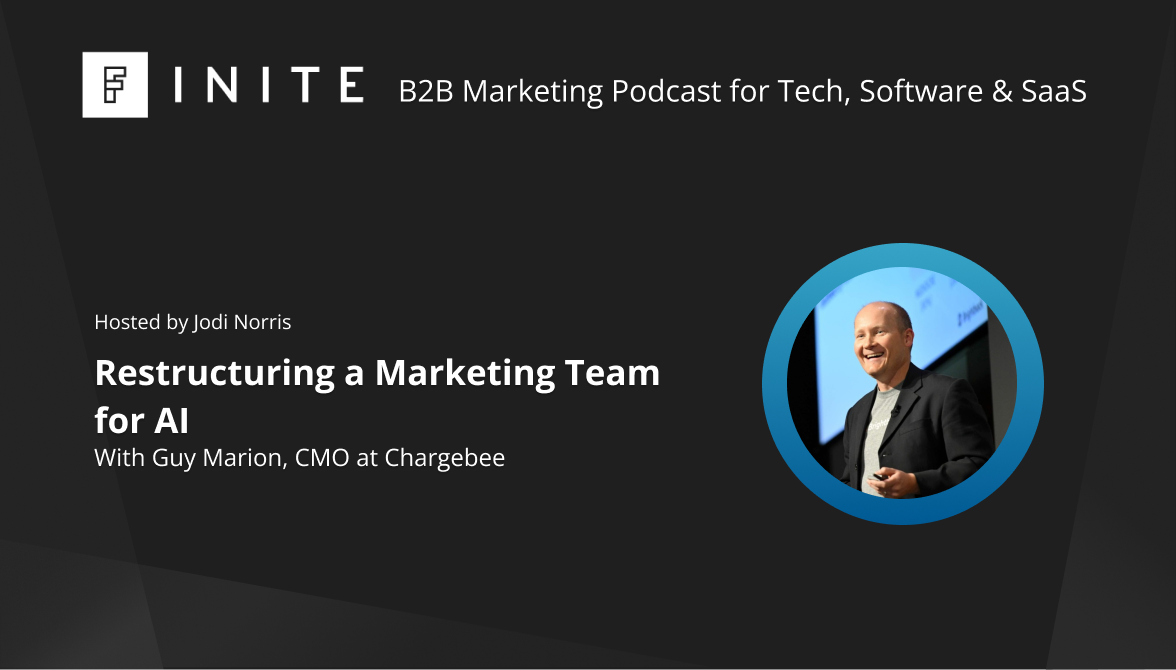
AI is significantly reshaping B2B marketing, potentially leaving you excited about the future of work or anxious about getting left behind. Either way, this episode aims to shed light on an AI-first marketing team – how to build one and how to operate in one.
You’ll hear from the highly entrepreneurial, Guy Marion, CMO at Chargebee, to unpack how he’s moving fast, and thoughtfully, on an AI-first strategy, including major team restructures and exciting workflows. Guy shares what has changed, what has improved, and how his team feels about the transition.
What you’ll learn:
- How a CMO approached an AI-driven team restructure – what was enhanced, what was created, and why.
- Practical ways AI increases marketing effectiveness across the funnel.
- Tactics for driving adoption – onboarding, enablement, and change management.
- What AI can’t replace, and blending creativity with speed.
- How to rethink workflows and metrics for an AI-collaborative future.
Note: We’re not advocating broad team restructures. Guy’s approach was designed for Chargebee’s specific context. Our goal is to give you a clear, candid look at an AI-first marketing team, so the future feels less scary and far more proactive.
Listen below, on Apple Podcasts or Spotify
Or watch on YouTube
And once you’re done listening, find more of our B2B marketing podcasts here!
The FINITE Podcast is sponsored by Clarity, a full-service digital marketing and communications agency. Through ideas, influence and impact, Clarity empowers visionary technology companies to change the world for the better.
Find the full transcript here:
Hello, Guy. Thank you for joining on the Finite podcast. Jodi, thanks for having me today. I’m looking forward to this. Me too. I think this is going to be a very interesting episode and unique and also very enlightening.
I feel like a lot of marketers are feeling a bit stunted by how they use AI, how they adopt it, how they get their teams to.
So I think this might provide a bit of inspiration or a bit of a different perspective on the meta.
So I’m really excited for that. But before we talk about our topic today, I’d love for you to explain your background in marketing, how you got to charge me and where you are now.
Sure. Well, thanks for that. And my background extends back to Zendesk, my first company I co-founded. I was at Autopilot, which is a marketing automation platform as the CMO and president there.
And then more recently, I founded Brightback, which was a customer retention platform for subscription businesses.
We were acquired, I was the CEO at the time, by Chargebee in 2022. I joined Chargebee then as the GM for the retention business, and then transitioned into the role of chief marketing officer, leading our GTM strategy across all of Chargebee’s products a year later in 2023.
So I’ve had a transitional role, always with a heavy emphasis in the marketing front, but also spanning into some of the sales and some of the product aspects of the growth businesses.
Awesome. So you’ve got a bit of a balance between that entrepreneurship and marketing, of course. I don’t feel like you see that often. I feel like entrepreneurs are usually on the sales side or on the technical side.
So yeah, really interesting to hear that perspective. So let’s just start with a bang. Why don’t you give us a quick summary of how… You’ve made space for AI within your team and the big, major, most important changes recently.
Yes. So Chargebee is a billing and monetization platform for SaaS businesses, for AI businesses, and for consumer services.
Companies like Calendly and Freshworks and Zapier on the B2B side. AI companies like Depot and Gorgias, as well as consumer leaders like Condi Nast and many others in the space.
This year and last year, like many in the industry, we’ve recognized that the future with marketing is an AI first one.
And it’s one that we need to all embrace and get behind because it is only increasing in terms of its impact in our professions and frankly, the opportunity to help us all improve.
So this year, we have reimagined marketing from ground up. building on the principle that we’ll be leveraging AI and automation to multiply the impact of every one of our high-performing marketers with tech and automation as a core use, if not a core competency.
And to support that, the first step was actually in this year-long strategy has been to go through a restructuring of the team that impacted about 40% of the team.
So it was a significant resizing to both create the budget and the room and moreover the cultural and the skill alignment and the space to move into more agentic AI-first ways of working.
Wow. Some big changes in your team, though. A bit of a side question. You mentioned culture. How did you decide how that structure turned out and who was kind of more critical to the future of Charge B?
Yeah, I mean, these are obviously very difficult… experiences that many in the industry like myself are having to go through right now and like our teams.
And we really said, you know, how are we going to be able to embrace technology and AI in a way that spans our playbooks, our culture, our metrics, how we’re measuring ourselves.
And really that means sort of hiring and developing in our a players and those who are willing to think about the fact that can I first accomplish this task or this job to be done?
with AI or with agents before thinking we need a person there. So this requires, we look for those who are proactive collaborators, integrative thinkers, working naturally across teams, who set a high bar for their own quality of work and their own creativity and their speed of execution.
And then also those who actually are inspired by how far can they push the boundaries of whether it’s the content or the end-to-end lead generation tactic or the awareness plan, how far can they take that by themselves or with one or two others, connecting the different tools and the systems we have at their disposal?
And certain people lean into that. Other people are nervous about that. And right now we’re at a point where we really need those who are ready to dive in and are running towards that.
And it turns out it starts to become more clear who we’re running towards it and who we’re running away from.
Really interesting points. And that’s some very qualitative analysis, I guess, of the performance of your team. I guess this is an important point for marketers listening, whether that’s CMOs or more junior.
Do you think it’s very kind of a top skill for marketers to have or even a top interest for marketers to have in 2025?
Is this very openness to collaborating with AI? I think it is. I think it’s a critical skill. If you think about it, the traditional sort of skills for marketers are, you know, like we’re creative thinkers.
We also, you know, very much of my background, and I think many in the industry have been very data-driven as well, right?
So how can you measure the outputs of what you’re doing? Are you having engagement? Are you having impact? And using that to sort of iterate and evolve the types of contents, whether it’s points of view articles or best practices or listicles or so on, or the demand side, sort of what lead gen tactics, which channels are converting, what messages are customers responding to, what are driving into sales conversations, what are ultimately closing as wins or being lost as losses, and how do you compete?
So all of this now, I mean, the role is becoming much more programmatic, right? ChatGPT and Claude, they develop good content. It doesn’t mean we don’t need to be seeding the right information and having the original points of view, but what traditionally has taken a large chunk of the time, which is developing content, that’s been dramatically accelerated now.
So I think that those who are the pure writers who aren’t embracing the use of that, I think are needing to really re-examine where and how they fit into the space.
Whereas I think those who are sort of content strategists or demand creators are thinking about how to see that as a competitive advantage.
The best writers still produce better content with AI. There’s no doubt about that. They just do a lot more of it and a lot more variations of it too.
So instead of writing one piece, they can tailor that for three or four different audiences in the same time they traditionally might have just created one.
Absolutely. I think that’s a very interesting take. I think you could say that AI can be used to stratify kind of hyper-specialist marketers from more bigger picture thinkers and kind of higher level strategic focuses.
And I think it’ll be interesting to hear as we go on this conversation, the balance of both and yeah, how both of them can succeed in this AI environment.
within these teams. So I think if we’ve got, yeah. So I think it’s very clear that you are on the other side of this coin where you’re fully embracing AI, you’re allowing your team to fully embrace AI and you’re using AI to really streamline your processes and make your team incredibly efficient.
And we’ll get into the impact of that a bit later. But I just think for our listeners, it might be helpful where they’re toying with ChatGPT and their content creation, and they’re maybe thinking about hiring a AI agent as a sales rep.
Where do you think on this big plethora of opportunity that AI could create potentially, where do you think marketers should start on this journey?
Or maybe you can draw on your own experience. Yeah, it’s a great question. And so if you look at the first areas we identified, the very first thing was actually the sales development process.
When customers request a demo or generate a lead with our company, they in the past would have received either an auto response from a generic email system, more sophisticated companies would have dynamic content to insert to provide a little bit more personalization to that, or a person more likely responds back.
In many cases, working at high volume and copying and pasting and using scripts and using sequences that ultimately are actually pretty generic and still being triggered by a person.
We’ve recently implemented a tool called Relevance AI, which uses ChatGPT under the hood to provide a personalized outreach for every single inquiry that’s written as if it’s coming from me to you, Jody.
And I would know about what tools you’re using already and what your needs probably are based on your business model and based on how large you are and where you are located in the world and potentially what your title is and can on the fly, write an email to you.
That’s almost indistinguishable from an email that would be written to you by myself. And this is working. We launched this a couple months ago and we’ve seen uptick in response rates.
We’ve seen uptick in open rates and we haven’t seen any reduction in certain areas. We’ve seen increases already in, the AI-driven response to our customers.
And we’re expecting to see a much higher increase now as the higher reply rates convert into more meetings and then more deals and then more wins.
And in doing so, we’ve displaced a large chunk of time that previously meant that SDRs are responding frontline to these initial responses.
And we’ve been able to find, in some cases, opportunities for them to do more of the outbound sort of digging work that is AI more challenged.
And in other cases, that actually led to some reduction in our team size as well. So I think that the initial lead qualifications and obvious opportunity for companies, our content teams have done a terrific job of already capturing the voice of our CEO or myself and several others in the company, as well as their own historical content sets to create custom GPTs that can represent some of our original thinking, which after a quick interview and then feeding can produce, can produce very close to a, you know, a market ready piece of thought leadership content, for example, which we still go through lots of editing.
So at the end you wouldn’t see. And then the third is, you know, ABM and advertising. So account based marketing has been a sort of a Holy grail for marketers for end sales for a long time, which is know the accounts in the B2B world that they’re selling to.
and marketing to and drive content and messaging that’s very unique to that company and those people.
So instead of a generic blast to companies, you might be speaking to the CFO of Intel, for example, that you’re maybe specifically targeting.
And now we’ve developed agentic flows for capturing an idea or a set of messages at a base point that then can be produced into ads, landing pages on our website, as well as emails being sent that carry through a set of messages to that person in that company through to a page that dynamically shows that message for them.
And we’ve immediately seen an increase in the effectiveness of these outbound campaigns. That’s actually pretty much being driven in an agentic workflow by one person now who previously that would have taken three or four people.
And she is a adopter, a tester, a pusher. She understands the needs of the customer and at the same time enjoys using the tools to connect and then work with the right technical teams internally to enable that.
And that takes some time to build, but these are short-term wins. Yeah, awesome. That’s a great and inspiring starting point, I think, for a lot of marketers.
I’ve identified three kind of themes, just to wrap that up in a neat little bow. I guess the first is looking for… areas in your existing marketing strategy where you’ve got automation already that you can automate even more, I guess.
It’s lots of little actions that you can start to scale. I think the second one, which I think is super interesting, is actually looking at what AI can do for you at its existing level.
We… we have come so far in the past two years in terms of AI’s capabilities, and that’s only going to grow.
But I think taking a lay of the landscape and really understanding what AI can do, it can take up tone of voice really well, and it can write really good copy in that tone of voice.
And so applying that to your, your ex-co and your stakeholders and your employee advocacy is, is yeah.
Super interesting. And I think- Tonal voice and subject areas, subject knowledge even, like your actual past expertise itself.
Absolutely. Yeah, I have a question about that because we’ve been struggling with AI since the start where it’s kind of like a circulation of content and a reproduction of content.
And how will we ever create new content if we’re just regurgitating what’s already existing in Google?
Are you, do you, I guess that could be, a repurposing of content strategy in that, like, are you getting those content strategists to like feed that new information and like build content to feed the AI to create engaging and unique content with that, would you say?
Yeah, that’s a great, great point. Absolutely. First of all, with any of these tools, you know, we buy the enterprise version.
So enterprise chat, GBT enterprise, Claude from anthropic. that allows you to create siloed information that is not available to the broader market and to the model.
And then we’re feeding it with our own libraries of information. So that’s actually a new emerging role that is a different type of role, but like auditing, structuring, curating the knowledge that we want to push in there of everything, our products, our sales transcripts and calls, our past thought leadership content, the press coverage we get, the website content, the stories of our history.
the detailed product specs of all of our different products across our product lines, the points of view that we’ve had.
We are structuring that information so it could be fed in there. And then the way that I use it personally is I never start with GPT with a basic prompt, give me an answer at all.
It’s always I bullet point or I write out my perspectives on a given topic. Then I feed it in and say, help me create this punchier, more of an angle or I’ll write very specifically, I’m speaking to this audience in this place and I provide a lot of contacts and then it will return versions that progressively move me towards an original piece of content that’s been often just improved and sharpened and more contacts provided.
But in doing so, like I’m actually training it with each of those interactions as well personally. So I think when you have a safe private environment for using AI, Then a big job, like I would imagine in a podcast environment, is actually auditing and capturing all your historicals, feeding it through.
And then you could ask it to pull out trends from the last 30 markers you’ve spoken to about X and make suggestions.
And it can surface all new insights in a way that you may or may not have been able to in the past.
Thank you, Guy. That’s a great idea. And I will definitely look into that. Personal consultation here. Thank you. No, but that’s a great example. And I think that’s also a theme across the episode is really distinguishing the skills of the human input versus the automation of the AI and the evolving roles of content creators.
And on that note, I think that might be a good point to transition to the the team aspect of this and the culture aspect and how you reassure your existing team to adopt AI and motivate them to.
How did that look for you in this journey? Yeah, it’s a critical part, right? This is, you know, the boring word is change management, but this is a huge amount of change we’re bringing into the company, right?
Like how people work, how they think, how they even view themselves. And so I think the only hard part is upfront recognizing not everybody is suited for at least an initial wave of how we build out and reinvent ourselves.
And that was why we actually went through the more painful transition first of the team restructure so that we were confident after a significant amount of work with myself and my leaders on who were the right team to be going into this with.
Next is immediately transition to a safe space. We are now going through this transition together. The first thing we’re doing is we’re building a hackathon.
We’re bringing the entire team together. And we’ve gone through a process of saying, what’s your earlier point around motivation?
We’ve very clearly prioritized in the beginning, we want to use AI to do things that will either help improve your performance, and that can be measured in things like better lead, better pipeline, better engagement from your activities, or to reduce the most inefficient use of your time that are tasks that take higher than, say, 20% of your time that’s repetitive that we could replace.
So we were very specific. There’s many things you could imagine. Let’s focus on those two, significant time savers or performance improvers.
And then from there, we have very practically taken a survey of the entire team, asking them to fill out examples of jobs they do that they think would either help improve performance or significantly save them time.
We’ve then, as a team, voted and agreed upon what the top five would be, or the top 10, excuse me. We’ve then gone through a process of defining those use cases, what the current state is, what the future state they would imagine would be.
And then I’ve also restructured with our, or I should say realigned, excuse me, with our, and companies are doing this all over the industry, with their IT and their operations teams, who are also implementing rapidly new AI tools, helping identify which of those are the most critical that we need to purchase first.
And then based on the use cases that team has helped create, and for us, for example, those include scanning sales calls and capturing key moments in those calls from transcripts that call out significant pain points, significant needs, turning points in the conversation, key stakeholders and words they said that transitioned the tone or the direction of a call, and then extracting those out in a way we can capture that and package that into our marketing, which again, you can feed that original content into our GPT, and then from there pull out what are the key moments in a typical call with this type of buyer and this type of company and this type of industry that changed the trajectory of a conversation.
We’ve pulled out like two case study creators, using info provided to us from our customers, but also how our customers are using our products, which we pull from other data, like competitive intelligence.
So what are our competitors doing based on web searches, based on feed from our Google Analytics, based on third-party tools we use for share of voice in the press, based on launch materials that our competitors are putting out about themselves.
So we can improve our intelligence gathering in a much more automated and structured way. Keyword discovery for search, whether it’s paid, organic search, and now increasingly a big area is for AI search and search queries.
And then five is email nurture ninja. So helping ourselves create emails that are going to be able to reach out and invite people to our events or nurture inquiries into our companies.
So we’ve basically pulled out these use cases. And then from there, we’re running a hackathon where our teams have mapped that out.
We’re going to have the teams and the IT teams enable the data sources pulled into the AI platforms that we’re using so that those data are live by the time we do a hackathon.
And then we’re going to use the hackathon to create the most interesting and powerful outcomes that day and vote on it.
So really what we’ve done is we’ve created a process for everyone to get involved in how to think differently about their work using the data that’s all now available to them for the first time in the company, and previously would have required days, weeks, months, or just impossible levels of effort to gather insights into sort of where we can learn about our customers, what tactics and strategies are working, and what the downstream impacts of those are.
We’re pulling all of that now, or we’re on the path to pull all of that into the upstream creation that we’re doing.
And I would say that our team is motivated and generally speaking, fairly inspired by what this means to help them, frankly, have a greater impact in their careers and in the company.
Yeah, absolutely. It is pushback too, though, but anyway, I’ll talk about that later. Yeah, yeah, let’s definitely talk about that. I think it’s interesting because marketers know best that b2b prospects just they just want to achieve their kpis they want to do their job better and so you’re framing ai as a way to do that so it’s almost this internal marketing piece of ai and also i’ve been thinking a lot lately about how um motivation comes from within teams when they have the ideas themselves so i think it’s really interesting that you’re empowering your teams to actually come up with the ideas of how they can impact and and benefit their own jobs and their own workflows using AI instead of kind of just thrusting it upon them.
So that’s really interesting. There’s a couple of questions floating through my head right now, but I think you pulled out a really great one.
What has been the pushback on this and how do you overcome that? Yes. I mean, the main pushback on this is it requires a lot of admin time.
is the way to think about this. It requires a lot of pausing from doing work and having to sit back and think about what is the work that I’m doing and what is the work that, and how can I improve that, that takes time out of our everyday busy schedules.
And so one area is just simply realizing that part of the job is going to be now, and we have to evolve the workforce to account for this, but part of the work is auditing and feeding the LLMs is actually in our interests as producers and creators to do.
And that is pretty manual and very time consuming. So one has been just getting the teams to create that marketing knowledge you were asking about earlier.
And we’re going to need to ultimately have the right types of people and roles for that. So that’s one. I think the other is definitely people are concerned about the fact that the time they spend creating each of those elements you summarized a few minutes ago automating automation even more.
Really what that is, is like taking the aspects of an automation and making it more personalized and more relevant for the audience to get better performance.
That would have been, you know, a significant use of multiple people’s time in the past. And we’re saying, let’s use an agent flow to do what you used to do.
There’s even with progressive thinkers, there’s a sense of loss and concern. So part of my role is to help drive that we have the team that we are working with.
And we’re looking to push the boundaries and be the best that we can be in our industry using the tools at our disposal.
And if we ever have those moments of self-doubt that am I becoming less relevant? We believe in all the team we have today have unique creative insights.
We’re asking them to multiply themselves and use AI to extend their capabilities, even if it means taking away some of the tasks they’ve done before.
Because there’s other things on everybody’s list of ideas and dreams and wishes that they’ve always had to put in the back burner.
We’re saying, let’s do more of that. Yeah, definitely. I think you’re right though. Change is always going to feel like a loss in some way. And it’s might be a gradual transition, but I guess yeah, the, the opportunity that you win is more than the opportunity lost.
So for your, for your existing team. So that’s, Yeah. That’s interesting. I think the upfront manual labor is, it is a bit of a ball lake, but if it’s going to turn out that things will be more effective and efficient in the long run, and you’re going to have more time to focus on those things that you’ve always wanted to do, then it feels like an easy win that one.
So, um, I we’re getting to the end of the episode. Now I have a few more questions that I really want to ask burning questions.
Um, And we’ve mentioned this a couple of times throughout the episode, but I just want to say more explicitly or ask more explicitly, what can’t AI replace?
We’ve talked about a lot of really exciting ways that AI is transforming your function, but yeah, what can’t AI replace?
Yeah, great question. And I feel very passionate and strongly about this as well. So the best and great marketers and just generally collaborators, creators, are naturally, the seeds of creativity are what they bring together.
They’re making associations from conversation A, B, and C, or insight A, B, and C. I think there is a risk with AI. Lazy AI could very much lead to mediocre results.
There’s no doubt about it. If you ask AI, it’ll give you confident, clear responses to any question that you’re gonna say, oh, that reads pretty well.
I should use that. Probably no one had ever thought of that before. It’s funny how I’m now starting to see similar wording coming at me and emails and so on, where it’s pretty clear.
Obviously you can tell if something’s written clearly by AI, but even the insights are similarly coming from different people.
So it’s pretty smart at synthesizing generic requests into its responses. So I think that it’s important not to be a lazy AI user. to start off with your insights. In fact, you should put more time into your insights.
And I think that that is never going to be replaced, not anytime soon. And I think just in the last several weeks, actually, in the industry, some of the sheen of AI is that it could be soon moving towards AGI.
That’s further in the distance. And we’re starting to recognize this is a technology that benefits us as prior waves have done.
And it’s not, you know, we’ve kind of started to reach kind of a leveling off of how far it’ll advance and change it.
We’ve gotten used to the idea. It can create great content and great, good insights very quickly, but it only goes so far.
So I think that the original insight, the creative source, uh, those are going to continue to differentiate the great companies from the good or the mediocre, the lazy.
Um, and I think for all of us in the profession, um, we need to be thinking more, not less about how to, um, how to dedicate the time to learn and listen and connect and synthesize and then develop like more journaling, potentially using GPT and more capture of that information since that’s going to become an increasingly precious resource in the future.
That’s really interesting. Yeah. We often hear that you only get what you put in, get out what you put in and AI is certainly no exception to that.
I think you’re honing in on a, an interesting vision of the future of work in general and how we’re transforming from doers to thinkers almost.
Um, and it will be interesting to see whether AI can even replace thinking, but it definitely hasn’t yet.
And I, I definitely think you can easily fall into the trap of thinking, Oh, AI can do my work now, but really you’re actually just leveling up your own mind.
So super interesting. Um, Do you think, yeah, I mean, looking ahead to the next two, three years, I mean, the last two, three years has already moved so quickly.
How do you see the marketing landscape evolving at large? Do you think we’ll get closer to AGI? Do you think it will start replacing creativity? You might not have any idea at all, which is totally fine, but any thoughts that you might have?
Well, I think we all wish we had a crystal ball that would make our lives and our careers a lot more successful, but Look, I think that the general purpose platforms that have defined the last 20 years, possibly ever, of software anyway, general marketing automation platforms, general ad platforms, general even CRMs, general tools for email, I think what we’re going to see is more and more specific needs for specific situations.
And the reason for that is because LLMs, the AI layer, coupled with basic sending infrastructure can do a lot now, actually, right?
You ask the right questions about a user and feed it the right information. It’ll produce a good email, which can then be sent to the right email address based on some lookups.
So I think what we’re going to see is more specific use cases where with smaller teams, more nimble organizations that are honing in on specific areas and, you know, I think the reason that AI is growing so fast and the markets are much, much larger than they used to be.
There’s many more developers in the world. There’s many more companies that are emerging. I think the big platforms are going to have to either fight to stay ahead and you see these crazy, you know, like Facebook with their $100 million hiring packages, which also has been put on hold, by the way, as they’ve started to realize the AI wars are slowing down.
But I think we’re going to see more focus around key areas. I think companies differentiating not just what their products are, but how they’re going to market, how they’re online acquiring and selling, and how they’re pricing.
I think those changes lead to a lot of strategic shift thinking in terms of how companies are leveraging AI to market and sell their products.
And I do not think that human intelligence is going to be replaced anytime soon. I do think that there’s going to be a lot more content and noise in the world as there has been for some time.
I think it’ll increase. So I think, again, solving really important problems for the more specific targeted audiences, we’re going to move more down that path.
Everything is going to feel more relevant. Imagine like the Netflix experience of everything is probably where things are going, which is like I turn on Netflix.
I expect it now to tell me something that I want to watch tonight. And it’s not even a lightweight expectation. If it’s not, I’m turning it off. And if someone comes along with something better, I would probably watch that too.
I think the world is going Yeah, I’ve been thinking about that too, in terms of AI search and how a lot of companies are focusing on that now alongside their SEO and how it’s almost the democratization of companies in a way, because AI is going to pick up the specific sectors that you work in and the specific niche and the specific audience that you’re targeting.
And it means that people are going to have more access to these, very hyper-targeted, very well-positioned brands rather than the first one that shows up on their search feed.
So that’s interesting. Whilst there might be smaller teams, there might be more teams of marketers. So thank you so much. One more thing I’d give you as well is I think more human interaction.
I think podcasts are going to be on the rise, not the fall. I think that human face-to-face interactions becomes more, not less important in a world where behind screens and online, everything can be more and more can be generated by GPT.
So I think we’re going to see actually things like event marketing, meetups, podcasts, rich multimedia, multi-channel experiences are going to be on the rise.
They’re going to be, that’s how you differentiate yourself too. So I’m a big believer. I love that you brought me on a podcast today. Thank you. My absolute pleasure. It was fantastic.
very interesting conversation guy and definitely one that’s going to stay with me for a while. And I’m sure our listeners too. So I’ll wrap it up there because we’re at time now, but you so much for coming on.
Thank you, Jodi. Thanks for having me.