The traditional CMO career path is disappearing. Senior marketers are now expected to be strategists and builders – able to vibe code landing pages, wire up automations, understand agents, and ship prototypes alongside leading teams and shaping narrative. So what does a successful marketing leader actually look like in 2026?
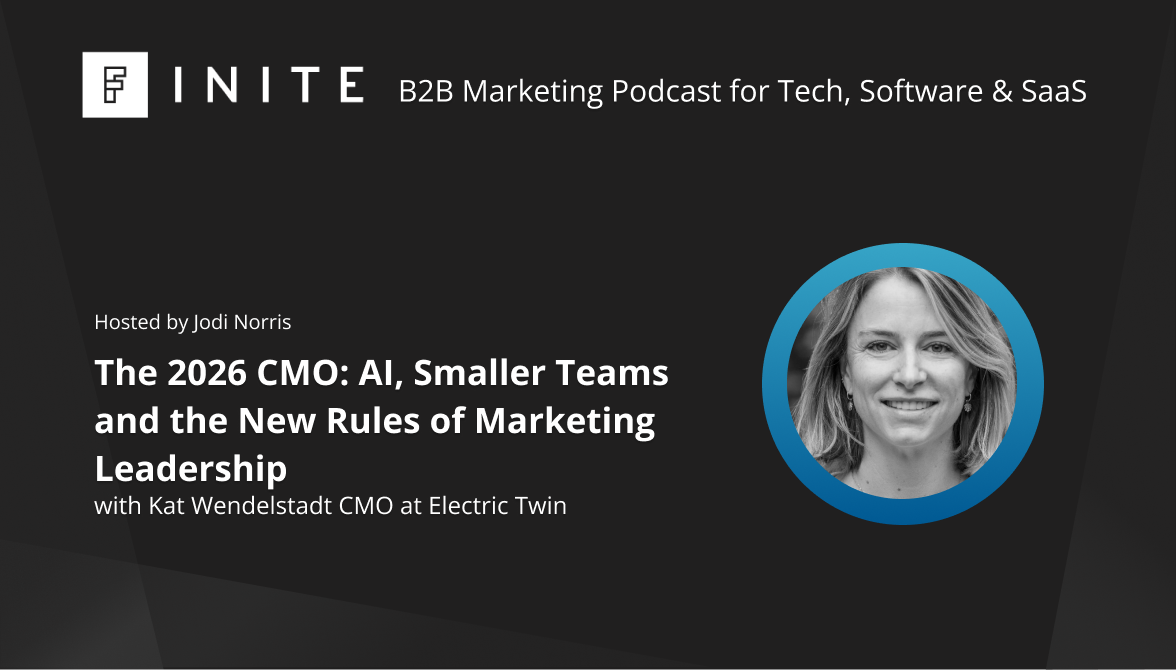
In this episode of the Finite Podcast, Jodi Norris sits down with Kat Wendelstadt to unpack how AI, economic pressure, and changing expectations are reshaping marketing leadership.
They explore why director and CMO roles are getting rarer, why salaries in some areas are dropping, and how AI is simultaneously shrinking team sizes and raising the bar for individual marketers.
Kat Wendelstadt is a seasoned go-to-market leader and startup advisor with a track record of scaling companies from early stage to billion-dollar valuations. A former GTM lead at Microsoft and three-time CMO, she has co-founded and advised ventures backed by investors including Sam Altman, Bill Gates, and the venture firm Founders Fund. She now leads marketing at Electric Twin, where she focuses on bringing its AI-driven synthetic audience technology to market.
Kat shares how she’s rebuilt her own skill set to stay ahead — from going deep on one AI platform, to building plugins and automations herself, to rethinking how and when to hire humans versus agents. She talks candidly about cognitive load, burnout risk, and why “having options” should be the north star of every marketer’s career.
If you want to stay employable (and in demand) as a modern marketing leader, this conversation is a must-listen.
Listen below, on Apple Podcasts or Spotify
Or watch on YouTube
And once you’re done listening, find more of our B2B marketing podcasts here!
The FINITE Podcast is sponsored by Clarity, a full-service digital marketing and communications agency. Through ideas, influence and impact, Clarity empowers visionary technology companies to change the world for the better.
Find the full transcript here:
Jodi: Hi, and thank you for joining me on another Finite Podcast episode. It’s no secret that the role of the CMO is shifting. I’ve seen countless white papers and reports tracking this shift, so I thought it would be great to hear from an innovative marketer who has actually ridden the wave of change themselves – and successfully, I might add.
Today, you’ll hear from Kat Wendelstadt, who has built an impressive career in tech VC, working with early to mid-stage companies to put them on the map. Kat has seen firsthand how CMOs and marketing leaders are expected to know how to vibe code, build plugins, and engineer workflows – on top of strategy and team leadership.
With fewer roles available and increasing demands, how can marketers secure their careers and meet the ever-growing expectations of their boards? How are hiring and team growth adapting? And what makes a modern marketing leader unemployable? All of this and more in this delightful conversation. I hope you enjoy.
Jodi: Hi Kat, thank you for joining me on the Finite Podcast today. It’s very lovely to have you here.
Kat: Thank you so much for having me, I’m excited.
Jodi: Me too. As we always do, I’d love to start by hearing a little bit more about your background in B2B marketing and B2B tech specifically, and how you came to your role at the moment.
Kat: Sounds good. My career kind of spans two phases: a big corporate phase and then a startup phase.
In the big corporate phase, I was at Microsoft as head of go-to-market for all of their hardware. That’s where I started my B2B journey. And then for the last 10 years, I’ve been working with startups at an early stage, taking companies from zero to one, and from one beyond.
I’ve specifically focused on AI-first companies more recently, since AI has come more to the fore. I met Electric Twin, the company where I currently work, through a network of VCs. I try to work closely with some top European VCs and then end up being on their roster, and that’s how I got the introduction.
Jodi: Really interesting background, and nice specialisms and pivots, which we’ll get into a little bit later. I’m curious: what is your proudest, or what you think is the most impressive, moment of your career? Any really successful companies you’ve worked with or big moments?
Kat: I’ve got two I would love to share.
The first is from when I used to live in Brazil for a long time. I joined an early-stage company called Dr. Consulta, which is a chain of primary care clinics – walk-in clinics. I joined them really early stage. They had maybe 20 people, and I joined as the CMO.
We had four clinics when I joined. By the time I left, 18 months later – which isn’t actually a huge amount of time – we’d grown to 40. The valuation had gone from 70 million dollars to close to 300 million dollars. We basically put that company firmly on the map in Brazil, and it was a new category. The market hadn’t seen this kind of fast-turnaround GP clinic model. So that was a really proud and successful moment.
It was loads of hard work, because if you do the math, we opened more than two clinics a month. The pace was absolutely brutal, but we built a really big brand and, in the end, got some great investors to join us on the journey.
The second one is a company that I ended up being the co-founder of. I was at a startup program in Silicon Valley called Singularity University, where you work on an idea that you’re passionate about. You find your co-founders in a sort of three‑month program.
We ended up creating a company called Helix Nano. This is a relatively long time ago, and now, 14 years later, that company is not only still going, but it’s thriving. They’ve built an mRNA platform that delivers vaccines at higher potency than Moderna, which currently has the most potent one on the market.
They’ve received investment from companies like Founders Fund, Peter Thiel’s fund, and it’s become a proper, viable business. Those are my two proudest moments.
Jodi: Really, really impressive, absolutely. Expanding healthcare and working in that space to actually create a positive impact is nice as well.
You said that you have loads of experience in the VC world – that’s kind of your bread and butter: really scaling from that early stage and putting companies on the map. It sounds like you have a really good understanding of the “economy of marketing” at large and the market at the moment for marketers.
Could you go into that a bit more to set the scene for the episode, and tell us about the economic and technological shifts that are really shaking up the marketing landscape at the moment?
Kat: Well, obviously the two letters are AI that are changing a lot of things, but that’s also influenced by broader macroeconomic uncertainty.
Budgets are generally getting smaller. When you have broader political shifts, they create uncertainty and brands are less likely to spend. That adds to overall pressure on budgets and output.
AI has transformed how every marketer is – or should be – doing their job. I think the danger for a lot of marketers is: how do you stay relevant? Senior people now need to be able to do work that you would typically have outsourced to an analyst or someone much more junior. You’ve got to be really hands‑on with the tools, in order to know what you’re talking about and also to ship. You can no longer just deliver strategy.
Another piece I think about a lot: if you stay in one business for a long time, you end up becoming very well-versed in that particular business, but you shut your eyes a little bit to what’s happening in the outside world. You know the politics and processes of that business, but the longer you’re there, the less optionality you might have. You might not have tried your hand at different types of roles or been really hands-on.
I’m talking specifically about director-level and above. Those roles are harder to come by, expectations are bigger, and if you’ve never really rolled up your sleeves, it’s going to be harder. I can see that happening at the higher level.
At the bottom level – and this is something that, as a mother, really concerns me – it’s also harder to break in. It’s so much harder to cut through when you are a university student or an intern looking for your initial work experience, because everybody wants candidates to already come “ready out of the box” with a full toolkit, who have already proven themselves and done things. So you get this pressure cooker on both sides of the spectrum.
A solution to that is what I’ve always thought about as the number one thing you want in your professional career: to have options. Optimise your CV for options.
Jodi: Really interesting. It’s fascinating how the traditional trajectory of a marketing career is being squashed or flipped on its head. Usually you leave execution to the wayside as you climb in your career and you get to that CMO level. And now you’re saying that CMOs need to be executing and really in the weeds as well.
Are we talking just about scale‑ups or smaller startups and earlier-stage companies, or are you seeing this throughout the entire enterprise world too?
Kat: This is definitely happening in the startup and scale‑up space, because especially if you’re a first marketer, you have to do everything, and that kind of continues.
But today I spoke to the CMO of a very large global pharma company. While she is probably not on the tools herself, we had a detailed discussion about how they’re thinking about implementing AI, the different tools they’re using, which tool is working for them and which isn’t.
So while she may not be in the day-to-day, she definitely had a detailed knowledge of all the technologies and how they were being applied throughout her company.
Jodi: Really interesting. So what do you think a kind of day‑to‑day of a CMO in 2026 looks like, or should look like?
Kat: I think the main thing is practising what we preach. Time is… I’ve found that with the arrival of AI, I’m busier than ever. It’s not that I’m less busy – I’m actually more busy because I’m doing more stuff.
You have to carve out time to dive into something that you want to learn about and get better at. I enjoy building, so I think CMOs should have – even if they’re not doing it themselves – the ability to vibe code a landing page in Lovable. They should be able to ship a prototype of an idea so they can show it to the product team – how something might or should look – rather than just a whole bunch of text. I think that is a requirement in the startup/scale‑up stage for sure.
Ideally you would block out a whole morning – a big chunk of time – where you say, “OK, today I’m going to figure out how to set up code,” or “Today I’m going to figure out how to automate my first outbound sequence,” just so that you are up to date with what your team might be doing and so you can give the right guidance. Otherwise you start becoming irrelevant.
Jodi: So it’s more about not necessarily using the tools on a day‑to‑day basis, but understanding how they work in order to optimise workflows and processes.
I heard something interesting recently about how we need to be careful with automation because it can stop you questioning whether something should be done, because it’s so frictionless and easy to do. So I guess it’s really about having an understanding of the impact of tools, the extent to which they can be used and whether we should be continuing to use them over time – constantly optimising at that high level. That still feels like a CMO responsibility and feels less like execution and more like strategy for execution, if that makes sense.
Kat: Yeah, that makes sense. I think it just depends a bit on the stage of company. More broadly, at larger scale it’s definitely more what you spoke about. If it’s a 20‑person business, you probably have to be properly on the tools. If it’s 200, 500 or more, then it goes more into what you were describing, for sure.
Jodi: Just to visualise this a bit more and give some key examples for our listeners to hold on to: can you tell us how you’ve adapted recently to anticipate new challenges and needs for marketers and CMOs in 2026?
Kat: I started this whole diving deep into AI two years ago, when you could properly do stuff. It was largely driven by LinkedIn. I started following some creators on LinkedIn and trying what they were doing – N8N flows, automation flows on Make.com, building an MVP.
So basically taking what I saw and learning: “OK, can I replicate this for my own workflow?” I very quickly realised what I was able to do and also what I was not able to do, and where it was worth spending my time.
What’s happened over the start of 2026 is that things are consolidating. Last year there was this explosion of tools and everybody was sharing how brilliant the tool was that they were using for different marketing use cases. I think a lot of it has consolidated on Claude.
I’ve been working with Claude for quite a long time, but I’ve moved away from trying lots of things and instead gone deep on one tool. As the market consolidates, that’s going to make more and more sense. I’m essentially building most things in Claude, and where Claude isn’t so good – in terms of visualisation, images, and certain other things – I’ll go to two or three other tools where it falls short.
But all the other connectors, you either build them yourself – you can now build plugins on Claude, so you can do your data visualisation for Google Analytics via Claude; you don’t need to learn how GA4 works anymore – and so that’s how I’ve been using it: going deeper on one.
Jodi: It really sounds like you are in the weeds. You’re coding, you’re creating plugins, you’re building landing pages, you’re working with AI. It’s interesting that it’s consolidating onto one core tool, and that makes it easier – that’s why platformisation has come about. It’s interesting to see that applied to AI, automation and AI agents as well.
To get a bit deeper into your story, I’d love to know: what does your team look like now, and how do you foresee your team growing and supporting you with your marketing as your current company grows? Will you still be in the weeds and expected to be doing all this kind of thing? What changes will happen to your role as the company grows?
Kat: That’s a really good question – I’m really excited about it, actually. For context, Electric Twin, where I work, is a company with 25 people. We’ve received 14 million dollars in funding. So we’re not super small, but we’re late seed stage going into Series A.
I was the first marketer and had to do everything from scratch. That’s where all the hands‑on work came from. The way I’m building up my team now is that I like to take things to the absolute limit – to the point where I can no longer handle it – so I know where the gap is and who I need to hire first.
It became very clear that I had to solve two problems. First, I wasn’t quick enough. Second, I needed to produce more content, more output, more storytelling.
My first hire is actually a freelancer – I like to hire freelancers first, then see if they’re good and make them permanent. So my first hire is a freelancer who does content and automations.
The second hire is a designer. We worked with a part‑time designer, but that’s no longer enough; they need to come in full‑time.
I’ve then hired an analyst – they’re starting tomorrow – so this month has been absolutely crazy, onboarding three people. The analyst is a product analyst, not a marketing analyst, who will really help us work from insights on how the product is being used, get insights on the ICP, and then start that storytelling piece. That will then be represented in messaging, positioning, and the assets that we create, and will help us connect the funnel end‑to‑end.
Those are the first three hires. What I can see coming down the pipe in a couple of months is a product marketing manager, and then at some point, somebody to manage email.
Jodi: And how are AI, agents and automation affecting your approach to hiring and team growth? Are you going to be limiting your hiring because of AI agents? Do you think they can replace marketing roles entirely – especially some of those junior, more execution‑focused ones? How are you handling this conversation?
Kat: I don’t think they will replace everything. There’s all this excitement about Adam Robinson, who’s a big LinkedIn influencer, running his 10 million dollar business with three people and everything being run by agents. You probably can do that if it’s a very prescriptive flow and there’s not much creativity or feeling, and then you just use the humans to do the storytelling out front.
That’s not how we think about it. At Electric Twin, we serve very large enterprises. To get in front of a large enterprise customer and engage them, it’s not by filling their inbox with AI‑generated messages. It has to be more white‑glove and personalised. You have much better cut‑through. It takes a bit longer, but the response is much bigger – especially because of this AI slope. So actually it’s a bit of “go slower to go faster.”
In terms of team size, I’ve been in a similar‑sized business a few years back that was very sales‑led. At that point I had 30 people under me. I think the biggest this team would get is maybe 10. So it is definitely smaller. I don’t need to be creating sales decks from scratch, for example – that can be done automatically after a sales call, and then I just change a few details.
So: fewer people, but the people who are working have to be creative, they have to have taste, and they have to know the tools.
Jodi: Thank you for that. I think it’s interesting – we’ve weighed a lot of pros and cons in this conversation so far. There are fewer marketing director roles, as you said, but there’s more capability to expand your role, be a bit more generalist, and have your fingers in all the pies.
On the whole, do you think this shift is positive or negative for marketing leaders? And if it’s positive, how can they take advantage of the opportunities it presents to benefit their careers?
Kat: I think it’s going to really sort the good from the bad. It’s going to be bad for some people, and really, really good for others.
It’s going to be really good for the people who are willing to lead the conversation. You have to lead from the front. You cannot be reactive and wait for things to happen to you. If you’re now inquiring about how to use AI for the first time, you’re very, very late to the conversation. That doesn’t mean you can’t catch up, but that comes through immediately in an interview because you just won’t have the depth of knowledge.
For the people who are leaning in: continue leaning in, and I think they will reap great benefits. I’m a better marketer because of AI, definitely. I have more output, more depth and more breadth than I used to have before. I may be a little bit too busy – that’s a downside – because suddenly, as it’s there, you end up doing more instead of less.
For some people, it’s going to be really hard. I’m in quite a lot of WhatsApp groups of CMOs, and you can see the jobs and salaries. Salaries are actually declining for the level. Yesterday I saw a partnerships lead at a decent‑sized company for 60k; I would have expected that number to be quite a lot higher.
I’ve seen head‑of‑growth roles at early‑stage companies advertised for surprisingly low salaries, and you’re like: wow, if that’s the benchmark, that’s kind of half of what you should pay a head of growth. So some people are definitely taking advantage.
Jodi: Yeah, that’s quite scary actually – the devaluation of marketing as a whole. Maybe it’s aligned with shrinking budgets and the idea that marketing can be automated, as opposed to a human‑centric specialism.
It’s always the case – I’ve heard this a million times – that engineers think the creative stuff can be automated, and the creative people think the engineering can be automated. It’s a bit of a back and forth of who has the most power in a company.
I think it’s interesting that you mention some of the negatives. I hear so many people saying, “AI has given me the opportunity to think more strategically. It’s lifted the burden a little bit; I’ve got this assistant in my back pocket.”
What do you think about the idea of cognitive load? If you’re having to be the vibe coder, make the landing pages, build the plugins, as well as doing the full piece of marketing strategy and messaging – the list goes on and on – how does that affect a marketer’s output, or even comfort and mental health levels at work? Have you thought about cognitive load at all?
Kat: Yes, definitely. And we also have lives on top of that, with admin and children and mortgages, things like that. The cognitive load is already high.
The problem with AI is that because it’s made you able to do stuff that before required a designer or a specialist, you end up doing more yourself. As you move through a company – and because we’re in a fast‑growing business – the first building phase is kind of finished, and now we’re entering a second phase.
The cognitive load is problematic, because if you’re thinking about all the little details that need to be done, you’re not thinking about the strategic stuff. So you really have to time‑box.
The way I do it is: I’m basically not available for meetings three mornings a week, where I just get stuff done. Either I do strategy, or I work through my workload. And then, as a company, we try to limit meetings to the extreme, because most of the time it can just be a Slack message.
Jodi: Yeah, absolutely. And hopefully, as your team grows and grows, you can delegate some of that cognitive load to them.
Great. I think that’s a really nice place to end. We’ve gotten so many insights from you on the changing CMO or marketing director role, and it’s really interesting to see the market and technological elements of 2026 combine to have a very big and direct impact on us marketers.
So thank you so much for coming on, Kat. It’s been an absolute pleasure.
Kat: Thank you so much for having me, it was great.